
Nothing Is Given. Ever.

I want to tell you about a race that started at 3pm on a Saturday afternoon and didn't end until 3pm the following day. A race where the temperature dropped to 5 degrees overnight, where fog rolled in across 25 kilometres of mountain roads with no warning, where the same patch of tarmac that was dry at hour two was underwater at hour four and bone dry again by dawn. Where drivers came in from a stint and couldn't explain to their engineers what the track was doing because the track itself didn't know yet.

That's the Nürburgring 24 Hours. And this year it delivered every single thing it's capable of.
The opening hours gave everything the Nordschleife is known for: changing weather, packed traffic, dramatic incidents and a relentless fight at the front. The race started damp, dried out through the afternoon under bright sunshine, then the rain came back as darkness fell. At any single point across the race, teams were running slicks, cut slicks, intermediates and full wets simultaneously. Not different teams making different calls. The same teams, across four drivers, making calls lap by lap based on which section of the circuit was wet and which wasn't. On a 25 kilometre lap. In the dark. That is the operational complexity of this race and most people watching from the outside have absolutely no idea it exists.
One driver described his stint as some of the toughest conditions he had faced all race, specifically struggling when the rain returned and the temperature dropped suddenly. You're doing this in the dark, on a circuit with 73 corners, with 160 other cars somewhere around you ranging from factory GT3 machinery to road-legal specials travelling at half your speed. There is no blue flag. You find them when you find them.
Lap One.
Lamborghini had locked out the front row in qualifying, the Red Bull Team ABT cars setting a pace nobody matched across the entire shootout. The fastest thing on the circuit going into that race. Before the first lap was done, the pole sitting car had been tagged going into Turn 2, suffered a puncture and dropped out of the lead fight. Not a crash. Not a catastrophic failure. A puncture from contact that forced an immediate pit stop. The fastest car in the field, from the best position on the grid, undone before a single lap was completed.
What happened next is what makes endurance racing different to everything else. By the end of 24 hours, that same Lamborghini was back on the podium in second place. Pole to puncture to podium. They spent the entire race recovering from something that wasn't their fault, never panicked, never overdrove, and ended up on the rostrum. That's not luck. That's what a properly prepared team with the right people looks like under sustained pressure.

Brünnchen.
There's a corner on the Nordschleife called Brünnchen. It sits deep in the forested section, away from the crowds, away from the cameras for most of the race. In the early hours, a car from a completely separate class left oil on the circuit there. Estre lost the Manthey Porsche on it immediately: and minutes later, the Mustang hit the same corner, the same oil, same outcome.
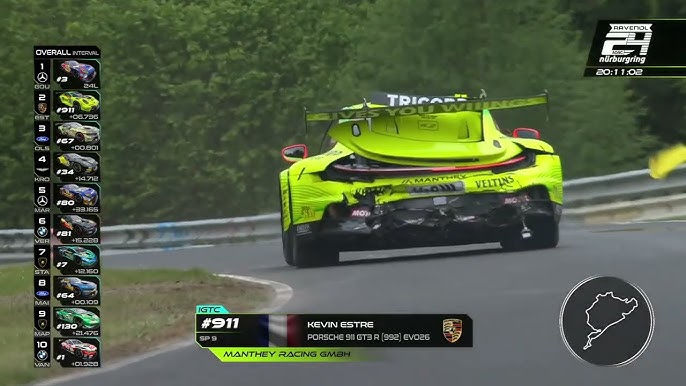
That Mustang was being driven by Arjun Maini. An Indian driver, competing at one of the most demanding events in world motorsport, running competitively before the circuit took the decision out of his hands entirely. Not a mistake. Not an error of judgement. Oil on tarmac in the dark, and nothing to be done about it.

Think about what that means. Two of the top contenders. Two completely unrelated races. Ended by the same patch of track that neither created, neither could have seen, and neither could have done anything about. This is the brutality of the Nordschleife at night. The circuit is so long that by the time a marshal has reported an incident, by the time the information has travelled from a post deep in the forest to race control to the drivers, three or four more cars have already been through that section. At racing speed. In the dark.
You can do everything right. Absolutely everything. And still lose to a corner you never saw coming.
The Estate Car That Shouldn't Have Been There.
I need to talk about the BMW M3 Touring.
This car started life as an April Fool's joke. BMW posted a concept on April 1st 2025: a five-door estate with a full GT3 aero kit and a rear wing so enormous it shouldn't exist on a family car. Half the internet thought it was real. BMW confirmed it was a gag. Then 1.6 million views happened, and the comments section looked less like mockery and more like a petition. BMW M Motorsport listened. The entire project, from approval to race-ready car, took eight months.
Through the mid-race hours it was running at an overall top three, matching the pace of the GT3 class, cutting through traffic in a five-door estate on a 25 kilometre mountain circuit in the rain and dark. The paddock lost their minds. It finished fifth overall and won its class.

One of the drivers in that car was Ugo de Wilde. In 2021, Ugo coached me at Magny-Cours when I was racing in French F4. Patient, precise, knew exactly how to get the best out of a driver still figuring out what he was capable of. Watching him put in that performance at the Nürburgring, in a car nobody believed in, on the hardest circuit on earth, finishing fifth overall against GT3 machinery: that's not something I take lightly. That's built on thousands of hours of work and a level of discipline that very few people understand from the outside.
Ugo. Properly done mate.
The YouTubers Who Showed Up.
Jimmy Broadbent has been posting sim racing videos to YouTube since 2012, the first four years produced from a shed at the end of his mother's garden. Steve Brown built his following the same way: karting videos, sim racing content, Gran Turismo. Misha Charoudin did thousands of tourist laps of this exact circuit on camera before anyone considered him a racing driver. Under the Black Falcon Team Fanatec banner, the three of them have been working their way up the Nordschleife ladder since 2023, earning their race licences properly, winning NLS races, doing it by the book.

Their stated goal coming into this year's race was a class win. They'd finished second in class in both their previous attempts at the 24 Hours and they wanted to put that right. They didn't finish. The Nürburgring saw to that. But that's not the point.
The point is that they were there. 161 cars on the grid, and these three were in one of them. Not as passengers, not as content. As drivers who had put in the years, earned the right, and lined up on the same grid as factory programmes and professional endurance racers. That is what this race means and why it matters. It's one of the only events in world motorsport where that grid is genuinely possible: where the best factory teams and a group of YouTubers who learned to drive on a simulator share the same start line and the same 25 kilometres of circuit for 24 hours.
Just being there is the result.
Hour Twenty.
The team that had led through the night ran a deliberate strategy: the sister car holding a patient line behind, told specifically not to fight, just to manage, wait, stay clean. Still leading comfortably with four hours to go. Then a driveshaft failed. Not from a crash. Not from an incident. A component that had been running perfectly for twenty hours simply reached its limit and stopped. The driver was just two laps into his stint when it happened. The car went into the garage. Three hours of repairs. It rejoined in the closing minutes, classified 38th overall.

The sister car, which had spent most of the race being told to hold its position and not chase, inherited the lead and drove to the win. Mercedes' first Nürburgring victory in a decade. Two teams, same manufacturer, same strategy: one takes the win, one takes the loss, separated by a driveshaft that held together for one car and didn't for the other. That's the margin.
I've raced. I understand mechanically what a driveshaft failure means. It means something that was asked to do its job, did it without complaint for twenty hours, and then simply couldn't anymore. There is no dramatic warning. No smoke, no sound that builds. Just suddenly the car isn't moving the way it should be, and then it isn't moving at all.
What this race actually is.
People watch endurance racing from the outside and they see the start and the finish and the winner. They miss everything in between. They miss the tyre calls made in the dark by engineers working on incomplete information. They miss the driver who climbs out of a car after a double stint in cold rain, having held it together through the forest section alone, on a circuit he can't see the end of, at speeds that don't allow for mistakes, and quietly hands it over to his teammate and walks away. They miss the mechanics working through the night with headtorches on, prepping a car for a driver change at 4am, knowing they need to get it right in under two minutes or the whole strategy falls apart.

352,000 people came to watch this year. They camped in the Eifel forest. They stayed up all night. They watched a BMW estate challenge factory GT3 cars in the dark. They watched YouTubers race alongside professional endurance drivers. They watched a driveshaft end 20 hours of perfect execution in the space of two laps.
The Nürburgring doesn't reward the fastest. It rewards the ones who are still standing when everything else has broken.
And next month, Le Mans.
If any of this got to you, even slightly: the 24 Hours of Le Mans runs June 11 to 15.
The Nürburgring is the proving ground. Le Mans is the verdict. 62 cars, 186 drivers, the same circuit that has been running since 1923. Everything you just read: the attrition, the conditions, the margin between winning and losing measured in components and decisions made under sustained pressure, it all happens again, on a bigger stage, with more at stake, and the whole world watching.

Watch it from the start. Not just the highlights. All of it. Because the race isn't won at the finish line. It's won across every single hour that comes before it.


Comments